Summarize this text with artificial intelligence
Choose your preferred tool to generate a short summary of the text.
A waybill is known as a document type mandated by many transactions in commercial life. These documents, based on facilitating transport operations, ensuring mutual trust between parties, complying with tax procedures, and safely transporting products or goods, are frequently used in every field. You can quickly access all the details you need to know about waybills by reading the rest of the text.
What is a Waybill?
With the increase in commercial transport operations within Turkey, the question of what is a waybill has begun to be frequently raised. A waybill is a document prepared for having a good transported in exchange for a certain fee with the purpose of delivering it to recipients.
It is mandatory to prepare a waybill regardless of where the good in question is to be transported or by what means it is transported. Thanks to this document, long transport operations are facilitated and commercial transactions can be conducted more easily.

Why is a Waybill Used?
A waybill is extremely important in terms of keeping official records regarding products or goods. In particular, the documents must definitely be held by the vehicle driver to avoid any problems during transport operations.
The waybill bearing the stamp of the Ministry of Finance determines the value of the transported products. Every company active in the transport sector must issue this document for transport operations. The penalty for transporting goods without a waybill, determined against the parties in case of potential situations, changes every year.
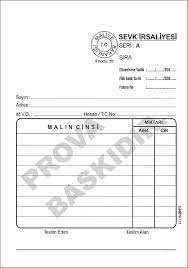
Waybill Example
The waybill, which is obligatorily issued in almost all transport operations, is prepared in triplicate. Each of these three copies must be held by the parties involved in the transactions.
The most important reason for this is its validity during official inspections conducted during the transport process. One copy of the document should be with the company commissioning the transport, one copy with the shippers, and one copy with the individuals carrying the product.
This document can be issued by almost any tax-paying business. This document, bearing the stamp of the Ministry of Finance, features the company name and address in the upper left corner. In the upper right corner, the serial and sequence number of the receipt is located. Throughout the document, information regarding the type of goods/products and many other characteristics is featured.
At the very end, that is, at the bottom of the text, important details such as the vehicle used, vehicle license plate, and driver's first and last name are present. With the completion of these sections, the waybill example, which finally features the signatures of buyers and sellers, serves as a guide for those who will perform this transaction for the first time. The invoicing period of the waybill varies depending on the companies issuing it.
E-Waybill
The waybill, which is one of the most frequently used documents in commercial transport operations, has begun to be issued electronically, just like e-invoices. E-waybill is not a new document type; it is the electronically formatted version of the existing document.
In this context, in cases where a waybill needs to be issued, an e-waybill must be prepared regardless of whether the recipient is a taxpayer or not. Correspondingly, if an invoice is to be issued in commercial transport operations conducted abroad, this document must also be an e-waybill.
How is a Waybill Created? What Information Should It Contain?
It is mandatory to issue a waybill in all trade transactions conducted in any field. This document, which has three copies in total, must be constantly kept in the vehicle performing the transport. This minimizes the risk of facing problems at the locations used during the transport of the goods/products.
The information contained in the waybill is of great importance so that all transported products can be recorded and classified in accordance with tax regulations. Almost all transport operations conducted without intermediaries depend on this document. However, there is no such obligation for transport operations carried out with private vehicles.
Another important point that parties must pay attention to during the issuance of the document is that the transport operation must be performed in exchange for a certain fee. Another point to consider is that the information in the document must be complete.
In particular, the information provided regarding the driver, i.e., the individuals/vehicles carrying out the transport operation, must be accurate. In addition to the driver and vehicle information, the names and tax numbers of the parties must also be clearly specified. This is a very important detail ensuring that the transport sector can operate in a certain order.

Relationship Between Waybill and Invoice: What are the Differences Between the Two Documents?
An invoice is a commercial indicator showing the price that customers must pay in return for the products or services sold. Important details such as date, sequence, and serial number are usually located on the invoice. Although waybills and invoices are documents that are frequently confused by people, there are some fundamental differences between them.
For example, a waybill cannot be used in place of an invoice. Furthermore, while a waybill is a document issued for the purpose of transporting a product or goods from one address to another, an invoice is issued directly for the sale of products.
How is a Waybill Used in Export and Import Processes?
In export operations, a waybill must be used in the transit process of the goods/products from existing warehouses to customs, and official documents provided by the Customs Administration must be used during the moving process continuing after the Turkish customs line. In import operations as well, documents provided by the Customs Administration are used in the transport of goods/products continuing from customs to the warehouse. The difference here is that the waybill is issued depending on the section-by-section transport of the products or goods.
How is a Waybill Used in Tax Procedures?
A waybill has a very important place in terms of subjecting commercial operations to taxation. Almost all domestic or international commercial transport operations are linked to the tax system. For this reason, companies that will commission the transport are obligated to issue a waybill. This way, the value of the transported products/goods is determined.