Summarize this text with artificial intelligence
Choose your preferred tool to generate a short summary of the text.
When exporting, companies have to fill out many documents. At the top of these is the e-invoice. An e-invoice is a mandatory document to be filled out for every exported order.
So, what is an e-invoice and how is it issued? Keep scrolling the page now for the answers to all the questions you are looking for.
What is an E-Invoice?
An e-invoice is a type of invoice issued in a digital environment. It is a document that is no different from a printed document. Just like in a printed invoice, the phrases and information inside are the same. It contains some information due to being digital. Other than that, there is no other difference. Even if an e-invoice is created in a digital environment, it can be printed on paper and reproduced. An e-invoice is issued to persons who are e-invoice taxpayers. If the person you are sending to is an e-invoice taxpayer, an e-invoice is automatically issued.
E-Invoice Examples for Export
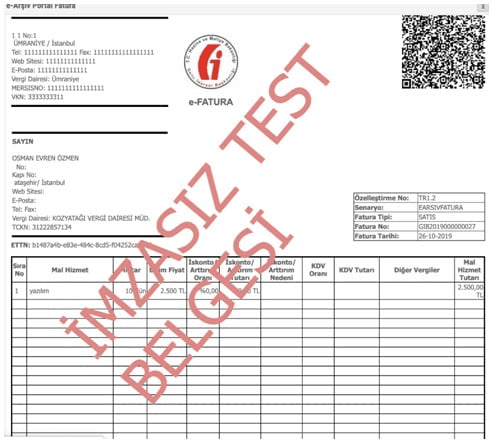
Below is an example of an e-invoice that needs to be created and filled out when exporting. You must create an e-invoice for each of your export transactions.
In Which Situations is it Obligatory to Issue an E-invoice?
As of July 1, 2017, it is mandatory to issue an E-Invoice.
• Export of goods in accordance with Article 11 of the Value Added Tax Law No. 3065 dated October 25, 1984
• Export accompanied by passengers
• Sales to non-residents in Turkey by calculating VAT
In such cases, the right to perform E-Invoice transactions arises. Those who are not registered in the E-Invoice system are not obliged to issue E-Invoices for exports.
What is the Mandatory Information That Must be Included in an E-invoice for Export?
When issuing an e-invoice for export, you are required to include the following information in the invoice. This information is as follows:
• Unit price of goods
• Delivery terms
• Sales price
• Quantity of goods (along with meter, kilo, pieces, etc.)
• The number, brand, quantity, type, and kind of the container in which the goods are located
• Point of delivery and payment of goods
• Mode of transport of the goods, details of air, land, rail, and sea routes
• HS Code (GTIP) number
• Tax office and tax number to which the seller is affiliated
• Customs tracking number for the goods/services
• Title of the company buying the product, or detailed information of the buyer if it is not a company
• Tax Identification Number (VKN) of the company purchasing the goods in the relevant country
• Account number to be paid (IBAN or SWIFT)
• Payment terms and method of payment
• Payment channel
Frequently Asked Questions About Issuing E-Invoices for Export
The most frequently asked questions and answers by users regarding issuing e-invoices for export are as follows.
Is E-Invoice Mandatory in Transit Operations?
The invoice for goods whose international transactions are processed with a Customs Declaration Form (GÇB) must be issued as an export E-Invoice. However, if the goods are not exported with a GÇB and the invoice sender is an e-Archive taxpayer, it must be issued as an e-Archive invoice. This can also be issued on paper as an old-style invoice.
Should Actual Service Invoices Also Be Issued as Export E-invoices?
The export of services cannot be subject to E-Invoices within this scope. The E-invoice obligation is only mandatory for goods exports.
Can Electronic Commerce Customs Declaration (ETGB) Micro-Exports Also Issue E-Invoices?
In transactions within the scope of micro-exports, there is only an obligation to issue an E-Archive or an old-style paper invoice. E-invoices cannot be used for this transaction. There is no regulation by the Ministry of Customs and Trade (GTB) or the Revenue Administration. A printed invoice is issued. (paper/e-Archive).
Should Invoices for Exports Made with International Cargo Companies be E-invoices?
Instead of the Customs Declaration Form (GÇB) within the scope of Micro Export, cargo companies use ETGB (Electronic Commerce Customs Declaration). At this point, E-Invoice transactions are not applicable. It is mandatory to issue a Printed Invoice for export transactions carried out within this scope.
Are E-Invoices Issued for Free Export Transactions as Well?
This situation varies depending on whether a Customs Declaration Form (GÇB) is issued or not. For free shipments that will be exported with a GÇB procedure, the invoice must be an e-Invoice.
Should an Exporter Carrying Out E-invoice Transactions Present it to the Customs Administration as an E-Invoice?
This is not mandatory. Since the original invoice is in the GTB system, there is no need to print it out separately.
Are Exports of Companies Located in Free Zones Subject to the Scope of E-Invoices?
If the intermediary company in the free zone is an E-Invoice taxpayer, it is necessary to issue an E-Invoice. It must be presented in this manner. However, there is no E-Invoice requirement for goods to exit the free zone. Because an export declaration is not in question for transactions to be made in the free zone. The declaration issued in the free zone is a transit declaration.